Co-Packer vs. Co-Manufacturer: What's the Difference?
A co-packer packs a product you've already made into retail-ready units. A co-manufacturer blends the ingredients and makes the product from your recipe. Here's how to know which one your brand needs.
# Do I Need a Co-Packer or a Co-Manufacturer?
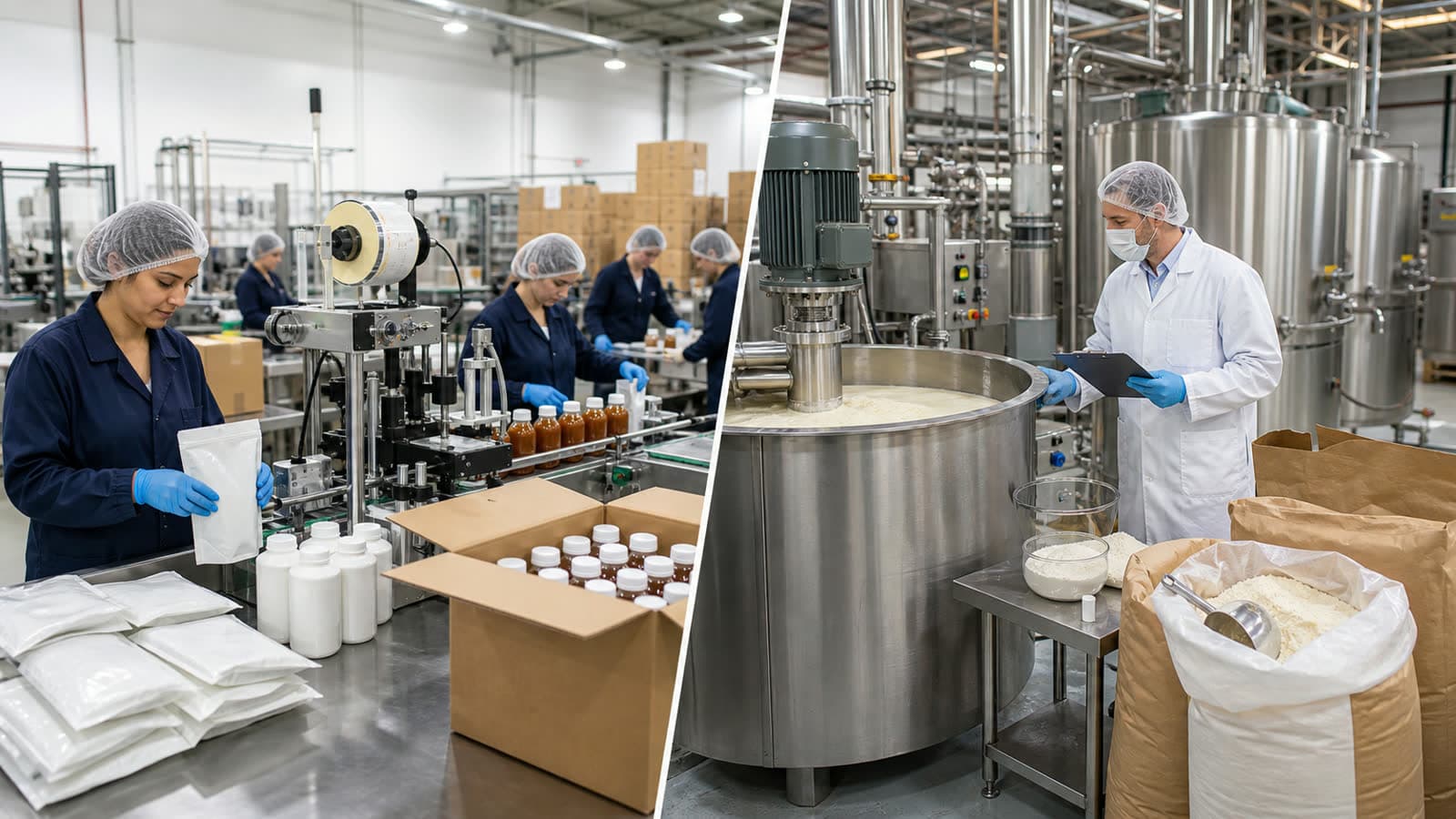
You need a co-packer if you already make your bulk product and only need it filled, labeled, and boxed at scale. You need a co-manufacturer if you have a recipe but need a partner to source ingredients and produce the finished product for you. The dividing line is who actually makes the product: you (co-packer) or them (co-manufacturer).
Founders use these two terms interchangeably, and it costs real money — choosing the wrong one means paying for capabilities you don't need, or discovering too late that your partner doesn't do the part you were counting on. Here's how to be sure before you contact anyone.
What a Co-Packer Does
A co-packer, or contract packager, focuses on the back end: taking a product you've already developed and making it retail-ready. That work includes filling and sealing your product into bags, jars, bottles, or pouches; applying labels that meet branding and regulatory requirements; portioning each unit to an exact weight or volume; and handling specialized packaging like single-serve packs, multi-packs, or promotional bundles. Sometimes a co-packer fills from bulk product that you or another maker supply.
You need a co-packer when:
-
You already make your bulk product in-house or in a commercial kitchen, but can't keep up with bottling, labeling, or sealing at scale.
-
You need a specific packaging capability — a format or run a full-service partner doesn't offer — while you handle formulation and sourcing elsewhere.
-
Your recipe is finished, and you want to hand over bulk product strictly to be put into retail-ready units.
What a Co-Manufacturer Does
A co-manufacturer, also called a contract manufacturer, handles the full production of the product — everything from sourcing ingredients to producing and packaging the final good. Their services can include ingredient sourcing (including specialty or hard-to-find ingredients), quality control at each stage to keep batches consistent, process optimization, and packaging and labeling. Because they handle more stages of production, co-manufacturing typically costs more than co-packing.
You need a co-manufacturer when:
-
You have a recipe but not the facility to produce thousands of units safely and legally at scale.
-
You want a partner to source raw materials in bulk, which can help manage your cost of goods.
-
You want one partner accountable for producing the whole product, not just packaging it.
Do I Need a Co-Packer or a Co-Manufacturer? The Quick Way to Decide
Start with one question industry partners themselves use: what stage is your product at — do you already have a finished recipe, or is it still in development?
-
If your product is already made and you just need it packaged → co-packer.
-
If you have a recipe but need it produced (ingredients sourced, made, and packaged) → co-manufacturer.
-
If you don't yet have a tested, shelf-stable recipe at all → you're not ready for either yet. Your first step is formulation — see below.
A note on the blur between the two: some co-manufacturers also offer recipe development and formulation support, and many full-service manufacturers package too, which is why "co-pack" gets used loosely. The distinction that actually matters is who owns formulation, sourcing, and testing. Get that in writing regardless of which partner you choose.
What If You Have an Idea but No Recipe Yet?
If you don't have a finished formula — no tested recipe, no shelf-stability information, no locked spec — you're at the formulation stage, before co-packing or co-manufacturing even applies. This is where a food scientist or a formulation-capable partner comes in: to develop the product, test it, and get it to a production-ready state. Only once you have a locked recipe does the co-packer-vs-co-manufacturer question become the right one to ask.
FAQ
- What is the difference between a co-packer and a co-manufacturer?
- A co-packer packs an already-made product into retail-ready units — filling, sealing, portioning, and labeling. A co-manufacturer blends the ingredients and makes the product from your recipe, then passes it to a co-packer to be packed (or packs it in-house). The dividing line is who makes the product versus who packs it.
- Is a co-manufacturer more expensive than a co-packer?
- Typically yes — because a co-manufacturer makes the product (and may also pack it), while a co-packer only packs it, co-manufacturing generally involves more stages and cost than co-packing alone.
- Can the same facility do both making and packing?
- Yes. One facility can both make the product and pack it under one roof. That doesn't merge the two terms — co-manufacturing (making) and co-packing (packing) still describe two different functions, even when the same company performs both.
Once you know which partner your product needs, start a search and we'll match your spec to the right kind of manufacturer — not just the nearest one.
Sources
All definitional claims in this post were verified against the following industry sources, fetched 2026-08-19:
-
GWP Group / UniWell Labs — "Co-Packing vs. Contract Manufacturing: Which Does Your Brand Actually Need?" — https://uniwelllabs.com/co-packing-vs-contract-manufacturing/
-
Superior Pack Group — "Co-Packer vs. Co-Manufacturer: Which Partner Fits Your Brand?" — https://superiorpackgroup.com/superior-pack-group-blog/co-packer-vs.-co-manufacturer-which-partner-fits-your-brand
Additional corroborating sources on this distinction, consistent with the above: GWP Group (gwpg.com/wp/contract-manufacturing-vs-co-packing-differences-explained), Wild Pack Beverage (wildpackbev.com/how-does-co-packing-work), Forbes (forbes.com/sites/square/2021/06/04/thinking-about-scaling-your-food-business-heres-what-to-know-about-co-packing). Verify any of these directly before publishing.